

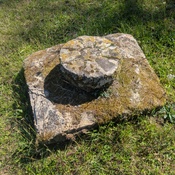
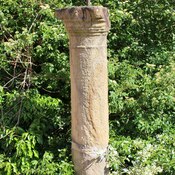
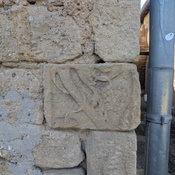
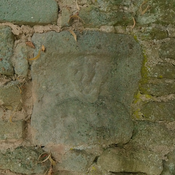

Extremely withered stoneblock original inluded into a wall at Reckweilerhof 13. The stone was transferred into the center (Crossing of Am Ring and the Mainstreet) of Wolfstein for public display in 2006 by its mayor, and is now used as a flowerpot.
Motive: Withered display of two persons, probably husband and wife. Original description of the side mentions a flute-playing person, probably Pan. 62cm x 61cm x 69cm, local sandstone often found in the area.
German newspaper article suggest that it could have been part of a grave, which was found between Aschbach and Reckweilerhof. The article is connecting the stone to an inscription found near that grave (Depot of the historical museum of the Palatinate, Speyer; Inv.Nr.: 2166 and CIL 13, 06176 a.) which reads:
[---]IAINONIS [---]
[---]a et Caran[---]-
[---]OM E T I V S[---]
[--- s]ibi {I} viv(u)s et c[oniugi? ---]
[--- h(eres)?] f(aciendum) c(uravit)
Maybe the two displayed persons were Ainonisa and Caranometius. This suggestion is not backed up either size or material used for the block, which is different from the inscription.
See:
- https://www.rheinpfalz.de/startseite_artikel,-blumenbeet-mit-bewegter-geschichte-_arid,343394.html
- H. Cüppers u.a. (Ed.): Die Römer in Rheinland-Pfalz (1990), 673.
- Malitius, Diethelm: Römische Inschriften und Skulpturen im Landkreis Kusel, Westricher Heimatbl. 18, 1987, 218.
- https://edh.ub.uni-heidelberg.de/edh/inschrift/HD075643