Il n'y a pas une annotation en français. Présenté est une annotation en Anglais.
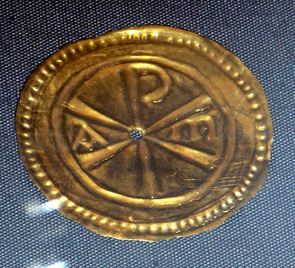
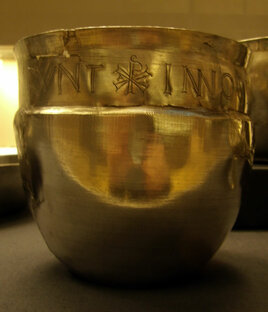
The Water Newton Treasure is a hoard of fourth-century Roman silver, discovered near the Roman town of Durobrivae at Water Newton in the English county of Cambridgeshire. The hoard consisted of 27 silver items and one small gold plaque. Because of inscriptions found on some of the pieces in the collection it has been suggested that they may have been used in a local church, and they therefore comprise the earliest probable group of Christian liturgical silver yet found in the Roman Empire.
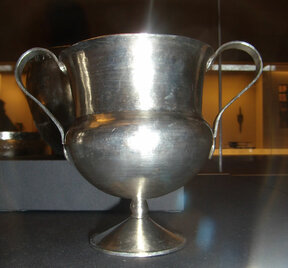
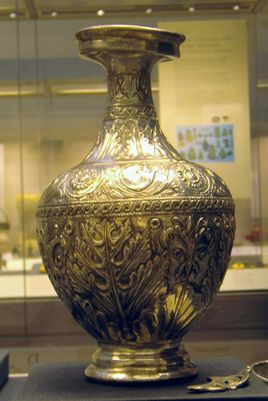
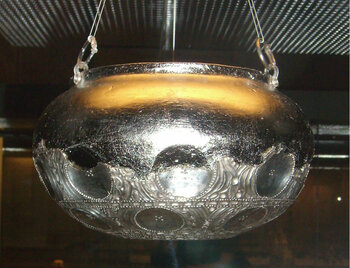
The hoard was discovered during ploughing in February 1975; several items were damaged by the plough. It was probably buried by an inhabitant of the nearby Roman fortified garrison town of Durobrivae. There are nine silver vessels, and the remainder of the items are votive tokens engraved and embossed with the labarum (the chi-rho cross), mostly of triangular shape. The larger items include jugs, bowls, dishes, a strainer, and an unengraved standing two-handled cup of the form (cantharus) later used as chalices.
Wikipedia page: https://en.wikipedia.org/wiki/Water_Newton_Treasure
The Water Newton Treasure is a hoard of fourth-century Roman silver, discovered near the Roman town of Durobrivae at Water Newton in the English county of Cambridgeshire. The hoard consisted of 27 silver items and one small gold plaque. Because of inscriptions found on some of the pieces in the collection it has been suggested that they may have been used in a local church, and they therefore comprise the earliest probable group of Christian liturgical silver yet found in the Roman Empire.
The hoard was discovered during ploughing in February 1975; several items were damaged by the plough. It was probably buried by an inhabitant of the nearby Roman fortified garrison town of Durobrivae. There are nine silver vessels, and the remainder of the items are votive tokens engraved and embossed with the labarum (the chi-rho cross), mostly of triangular shape. The larger items include jugs, bowls, dishes, a strainer, and an unengraved standing two-handled cup of the form (cantharus) later used as chalices.
Wikipedia page: https://en.wikipedia.org/wiki/Water_Newton_Treasure