Er zijn nog geen Nederlandstalige annotaties. Hier volgen annotaties in het Engels.
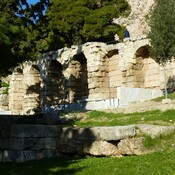
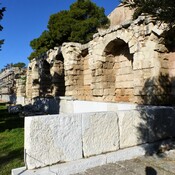
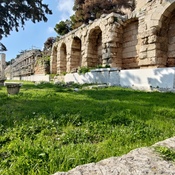
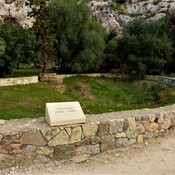
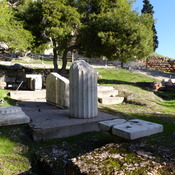
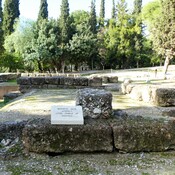
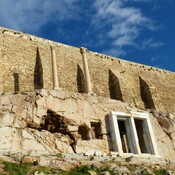
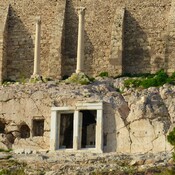
House of Proclus known also as House Chi, was erected at the end of the IVth or at the beginning of the Vth century1. It was only partially excavated and re-buried under the Dionysiou Areopagitou Street.
`House of Proclus` consists of a large main hall with a semicircular apse with three semicircular and four half hexagonic niches probably for sculptures, surrounded by smaller rooms. The floor of the hall was paved with mosaics in geometric patterns.
Two ancient votive reliefs were found in one East small room. There are also a relief base used as an altar for offerings or as a statue holder.
The ancient written sources all the findings allows to identify this building as the house of the philosopher Proclus, Director of the Neoplatonic School and important figure of ancient Athens. After Justinian’s edict pagans schools were abandoned and closed.
- Anna Afonasina, Eugene Afonasin, The Houses of Philosophical Schools in Athens in: Schole, 8(2014), s. 9 - 23.
- Arja Karivieri, The 'House of Proclus' on the Southern Slope of the Acropolis: A Contribution in: Aspects of Life and Culture in Athens A.D. 267–529, ( Ed.: Paavo Castrén) , Helsinki 1994, pp. 115-139
Bronverwijzingen
- ↑According to Dontas (1956) the building in its fina l form was constructed in the period between the end of the fourth and the beginn ing the fifth century C. E. Only the northern part of the area was excavated because “the rest expands under the area occupied by modern houses, in the back6yards of whi ch could be observed its traces and floor6mosaics” (his article in: Ergon tes Archaiologikes Etaireias kata to 1955 (Athena) 5–14, quoted in Oikonomides 1977: 11–12).
House of Proclus known also as House Chi, was erected at the end of the IVth or at the beginning of the Vth century1. It was only partially excavated and re-buried under the Dionysiou Areopagitou Street.
`House of Proclus` consists of a large main hall with a semicircular apse with three semicircular and four half hexagonic niches probably for sculptures, surrounded by smaller rooms. The floor of the hall was paved with mosaics in geometric patterns.
Two ancient votive reliefs were found in one East small room. There are also a relief base used as an altar for offerings or as a statue holder.
The ancient written sources all the findings allows to identify this building as the house of the philosopher Proclus, Director of the Neoplatonic School and important figure of ancient Athens. After Justinian’s edict pagans schools were abandoned and closed.
- Anna Afonasina, Eugene Afonasin, The Houses of Philosophical Schools in Athens in: Schole, 8(2014), s. 9 - 23.
- Arja Karivieri, The 'House of Proclus' on the Southern Slope of the Acropolis: A Contribution in: Aspects of Life and Culture in Athens A.D. 267–529, ( Ed.: Paavo Castrén) , Helsinki 1994, pp. 115-139
Bronverwijzingen
- ↑According to Dontas (1956) the building in its fina l form was constructed in the period between the end of the fourth and the beginn ing the fifth century C. E. Only the northern part of the area was excavated because “the rest expands under the area occupied by modern houses, in the back6yards of whi ch could be observed its traces and floor6mosaics” (his article in: Ergon tes Archaiologikes Etaireias kata to 1955 (Athena) 5–14, quoted in Oikonomides 1977: 11–12).