
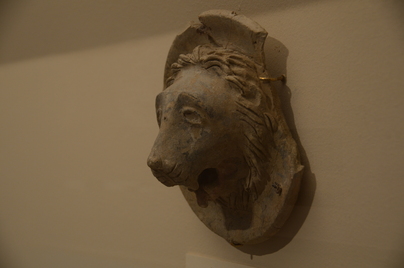
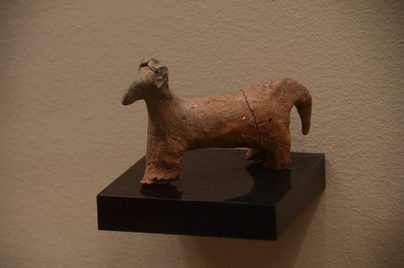

The Abila of the Decapolis is situated in the Wadi Queilbeh; its main ruins are located on Tell Umm el-Amad and Tell Abil, with a road, a basilica, an ancient theater, a bridge, and various other ruins extending between the two. Abila Decapoleos—also known as Abila Vinifera (12 miles east of Gadara)—has at various times been confused with Raphana. However, this confusion stemmed solely from the fact that scholars failed to immediately recognize Abila within Pliny's list, and thus simply substituted the only remaining unlocated city: Raphana. Yet, upon closer reading, Abila is in fact implicitly named even by Pliny the Elder—specifically within his enumeration of the Tetrarchies between the cities of the region. Here, we find "Ampeloessa"—"the Vine-rich Land." This description corresponds precisely to the area situated between Bet Ras and Abila. Even today—as was already documented by G. Schumacher—numerous place names in the region bear witness to this illustrious past (including names such as "Wine Press," "Ard el Karm," etc.). Later, like virtually all cities of the Decapolis, Abila became one of the earliest dioceses. As an episcopal see, it flourished until a severe earthquake struck in the 4th century, followed by another in the early 8th century. Excavations prove that the site was inhabited more than 5000 years ago in the early Bronze Age.
- Gottlieb Schumacher; G Le Strange,Abila of the Decapolis, Abila of Decapolis,Publications (Palestine Exploration Fund), London 1889 - http://babel.hathitrust.org/cgi/pt?id=wu.89092436096;view=1up;seq=1
- http://users.stlcc.edu/mfuller/abila/AbilaSurveys.html
- W. Harold Mare, Ph.D. Director, Abila Excavations Professor, Covenant Theological Seminary St. Louis, Missouri. "Excavations at Abila of the Decapolis, Northern Jordan", March 2004.-http://www.bibleinterp.com/excavations/Abila_of_the_Decapolis.shtml
- C Menninga, L Minc, MD Glascock, Neutron activation analysis of pottery samples from Abila of the Decapolis, Journal of Radioanalytical and Nuclear Chemistry, Volume 266, Issue 2, 2004, pp. 238-244