
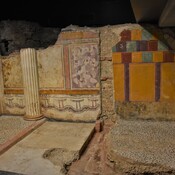
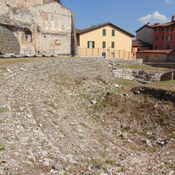
The Capitolium, built by the emperor Vespasian in AD 73, was situated on the decumanus maximus (on the line of Via Musei) and was discovered in 1823. It is a temple with three chambers, where the Capitoline trinity of deities was worshipped, and is based on the plan of the underlying Republican temple (probably constructed in 80-70 BC, soon after Roman citizenship was granted in 89 BC), which has also been brought to light by the archaeological excavations. It seems that the Capitolium originally had four chambers, a peculiarity due to the form of the preceding Republican temple, the easternmost of which was demolished to make way for an extension of the theatre. This fourth cella was probably used for the worship of a local deity, perhaps a Celtic god such as Bergimo, or maybe Hercules, given that there existed an oral tradition of referring to the Capitolium as the Temple of Hercules.
Inside marble fragments of an enormous male statue were found; others have come to light recently. The most probable intriguing explanation is that these came from a sculpture of the enthroned Capitoline Jupiter Optimus Maximus which dominated the central chamber; such a statue would have been modelled on that in the Capitoline temple in Rome, copies of which were installed in religious buildings throughout the empire1.

Omgeving:

Locatie:
- Italië, Brescia
- geo:45.540028,10.225788
- Locatie precies
Period or year:
- 1xx / unknown
Classificatie:
- Tempel of heiligdom
- Zichtbaar
Identifiers:
- vici:place=8480
Annotaties
The Capitolium, built by the emperor Vespasian in AD 73, was situated on the decumanus maximus (on the line of Via Musei) and was discovered in 1823. It is a temple with three chambers, where the Capitoline trinity of deities was worshipped, and is based on the plan of the underlying Republican temple (probably constructed in 80-70 BC, soon after Roman citizenship was granted in 89 BC), which has also been brought to light by the archaeological excavations. It seems that the Capitolium originally had four chambers, a peculiarity due to the form of the preceding Republican temple, the easternmost of which was demolished to make way for an extension of the theatre. This fourth cella was probably used for the worship of a local deity, perhaps a Celtic god such as Bergimo, or maybe Hercules, given that there existed an oral tradition of referring to the Capitolium as the Temple of Hercules.
Inside marble fragments of an enormous male statue were found; others have come to light recently. The most probable intriguing explanation is that these came from a sculpture of the enthroned Capitoline Jupiter Optimus Maximus which dominated the central chamber; such a statue would have been modelled on that in the Capitoline temple in Rome, copies of which were installed in religious buildings throughout the empire1.
Bronverwijzingen
In de buurt
Brescia Hortfund
Roman treasure of bronze elements found in 1826 and dated from 1st to 3rd century AD
Roman republican temple
Temple of the Roman republic
Teatro romano di Brixia BRESCIA
Teatro di Brixia