Il n'y a pas une annotation en français. Présenté est une annotation en Anglais.
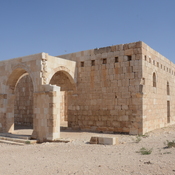
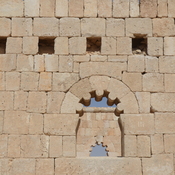
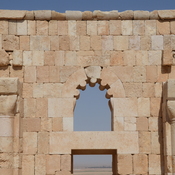
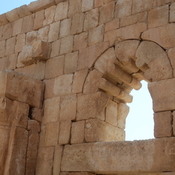
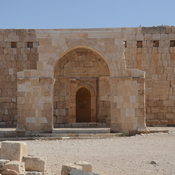
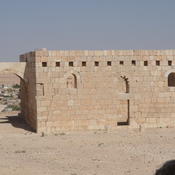
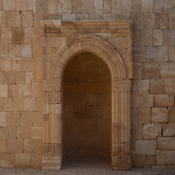
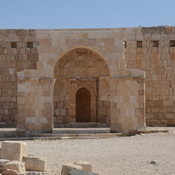
Roman fort known as Qasr el-Hallabat (in reports of H.C.Butler expedition as Koser il-Hallabat) stands on a knoll of Jebel Hauran. The structure made of basalt is a square over 40 m, supported with towers projecting at the angles. inside in small chambers along the walls were small water reservoires. Towers were built of limestone with basalt string courses. Qasr el-Hallabat was originally built during the reign of Trajan at Via Nova Traiana. Two inscriptions, one in Greek and one in Latin prooved the periods of rebuilding. One during the regn of Caracalla under the legat Phirnius was enlarged. In the sixth century during the reign of Justinian fortress was restored. In the seventh century fortress fell to the Arabs.
There were found Greek inscriptions on 160 basalt blocks.
See:
- Howard Crosby Butler eds., Syria: publications of the Princeton University Archaeological Expeditions to Syria in 1904 - 5 and 1909 (Div. 2, Sect. A ; 2) — 1909 pp.70-77 https://doi.org/10.11588/diglit.45581
- Qasr al-Hallabat, Written and photographed by Rami G. Khouri - https://archive.aramcoworld.com/issue/199005/qasr.al-hallabat.htm
-
QASR AL-HALLABAT (JORDAN): TRANSFORMATION OF A LIMES ARABICUS FORT INTO A MONASTIC AND PALATINE COMPLEX LIMES XX Ignacio Arce https://www.academia.edu/25105788/QASR_AL_HALLABAT_JORDAN_TRANSFORMATION_OF_A_LIMES_ARABICUS_FORT_INTO_A_MONASTIC_AND_PALATINE_COMPLEX_LIMES_XX
Roman fort known as Qasr el-Hallabat (in reports of H.C.Butler expedition as Koser il-Hallabat) stands on a knoll of Jebel Hauran. The structure made of basalt is a square over 40 m, supported with towers projecting at the angles. inside in small chambers along the walls were small water reservoires. Towers were built of limestone with basalt string courses. Qasr el-Hallabat was originally built during the reign of Trajan at Via Nova Traiana. Two inscriptions, one in Greek and one in Latin prooved the periods of rebuilding. One during the regn of Caracalla under the legat Phirnius was enlarged. In the sixth century during the reign of Justinian fortress was restored. In the seventh century fortress fell to the Arabs.
There were found Greek inscriptions on 160 basalt blocks.
See:
- Howard Crosby Butler eds., Syria: publications of the Princeton University Archaeological Expeditions to Syria in 1904 - 5 and 1909 (Div. 2, Sect. A ; 2) — 1909 pp.70-77 https://doi.org/10.11588/diglit.45581
- Qasr al-Hallabat, Written and photographed by Rami G. Khouri - https://archive.aramcoworld.com/issue/199005/qasr.al-hallabat.htm
-
QASR AL-HALLABAT (JORDAN): TRANSFORMATION OF A LIMES ARABICUS FORT INTO A MONASTIC AND PALATINE COMPLEX LIMES XX Ignacio Arce https://www.academia.edu/25105788/QASR_AL_HALLABAT_JORDAN_TRANSFORMATION_OF_A_LIMES_ARABICUS_FORT_INTO_A_MONASTIC_AND_PALATINE_COMPLEX_LIMES_XX