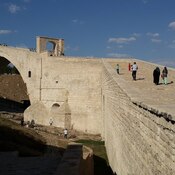
Il n'y a pas une annotation en français. Présenté est une annotation en Anglais.
Hallan Çemi Höyük lies in Kaletepe Village of Kozluk District 50 km north of Batman (ca 1 km to the West of Taşlıdere) . The Late Pleistocene terrace is located in the narrow Sason Stream Valley, on the western bank of this stream a tributary of the Tigris. It is site of the Epipalaeolithic-Neolithic-Transition ie.transition from hunter-gatherer to food producing societies and it seems to be the oldest known settlement in Anatolia. The hunter-gatherer community occupied the site 11,700 – 11,270 years ago,
This Proto Neolithic settlement in Southeastern Anatolia near village of Kalatepe, currently is partly flooded with water of the Batman Dam Lake.
The 4.3 m high mound which covers an area of 7 hectares was composed of three layers or occupational phases dating to the Aceramic Neolithic Period. Inhabitants of Hallan Cemi lived in round houses; which were built partially sunken beneath ground level and had roofs made of wattle and daub. This dwellings rarely exceeded 2 meters in diameter. This architecture is similar to that of Hasankeyf, Karahan, nd Gobekli Tepe. Site was inhabited ca 8600-8000 BC according to 14C. In the upper levels of the site the wild cattle skull, originally hanged on the wall was discovered in one of the two larger buildings (ca 6 m in diameter), and equipped with stone benches and plastered hearths. This suggestes the ritual or another social function of these structures.
The interesting feature was the presence of elaborately polished and decorated stone howls and sculpted pestles.
Sources:
- M. Güler, B. Çelik, G. Güler, Viranşehir ilçesinden Yeni Çanak Çömleksiz Neolitik dönem yerleşimleri - New Pre-Pottery Neolıthıc Settlements From Vîranşehîr Dıstrıct, Anadolu / Anatolia 38, 2012
- M. Rosenberg, R. W. Redding, Hallan Chemi and Early Village Organization in Eastern Anatolia (2002)
- Ian Kuijt: Life in Neolithic Farming Communities: Social Organization, Identity, and Differentiation. Springer Science & Business Media, 30. Juni 2000
- http://www.tayproject.org/TAYages.fm$Retrieve?CagNo=1223&html=ages_detail_e.html&layout=web
- Hallan Çemi Tepesi, http://tayproject.org/TAYages.fm$Retrieve?CagNo=1223&html=ages_detail_e.html&layout=web
- Michael Rosenberg: Hallan Çemi. In: Die ältesten Monumente der Menschheit. Vor 12.000 Jahren in Anatolien. [Große Landesausstellung Baden-Württemberg 2007 im Badischen Landesmuseum Schloss Karlsruhe, 20. Januar - 17. Juni 2007], hrsg. vom Badischen Landesmuseum Karlsruhe. Theiss, Stuttgart 2007, pp. 54-55
- idem: "Hallan Çemi Tepesi: Some Further Observations Concerning Stratigraphy and Material Culture" in Anatolica vol. 20 (1994) pp. 121-140
- idem: A Preliminary Description of the Lithic Industry from Hallan Çemi. In Neolithic Chipped Stone Industries of the Fertile Crescent: Proceedings of the First Workshop on PPN Chipped Stone Industries, edited by H. G. Gebel and S. K. Kozlowski, pp. 223–238
- idem: "Hallan Çemi" in M. Özdogan, N. Basgelen, eed., Neolithic in Turkey - The cradle of civilisation. New discoveries (1999) pp. 25-33
- M. Rosenberg, Mark Nesbitt, Richard W. Redding, Thomas F. Strasser, "Hallan Çemi Tepesi: some preliminary observations concerning early neolithic subsistence behaviours in eastern Anatolia" in Anatolica vol. 21 (1995) pp. 3-12 - http://www.ancientgrains.org/nesbitt1995hallan.pdf
- M. Rosenberg, R. Nesbitt, R. W. Redding et B. L. Peasnall, « Hallan Çemi, pig husbandry, and post-Pleistocene adaptations along the Taurus-Zagros Arc (Turkey) », dans Paléorient 24/1, 1998, pp. 25-41 - http://www.persee.fr/doc/paleo_0153-9345_1998_num_24_1_4667
- M. Rosenberg, Richard W. Redding, "Hallan Çemi and early village organization in Eastern Anatolia" in I. Kuijt, ed., Life in neolithic farming communities (2000) pp. 39-61 - https://link.springer.com/chapter/10.1007/0-306-47166-3_3
Hallan Çemi Höyük lies in Kaletepe Village of Kozluk District 50 km north of Batman (ca 1 km to the West of Taşlıdere) . The Late Pleistocene terrace is located in the narrow Sason Stream Valley, on the western bank of this stream a tributary of the Tigris. It is site of the Epipalaeolithic-Neolithic-Transition ie.transition from hunter-gatherer to food producing societies and it seems to be the oldest known settlement in Anatolia. The hunter-gatherer community occupied the site 11,700 – 11,270 years ago,
This Proto Neolithic settlement in Southeastern Anatolia near village of Kalatepe, currently is partly flooded with water of the Batman Dam Lake.
The 4.3 m high mound which covers an area of 7 hectares was composed of three layers or occupational phases dating to the Aceramic Neolithic Period. Inhabitants of Hallan Cemi lived in round houses; which were built partially sunken beneath ground level and had roofs made of wattle and daub. This dwellings rarely exceeded 2 meters in diameter. This architecture is similar to that of Hasankeyf, Karahan, nd Gobekli Tepe. Site was inhabited ca 8600-8000 BC according to 14C. In the upper levels of the site the wild cattle skull, originally hanged on the wall was discovered in one of the two larger buildings (ca 6 m in diameter), and equipped with stone benches and plastered hearths. This suggestes the ritual or another social function of these structures.
The interesting feature was the presence of elaborately polished and decorated stone howls and sculpted pestles.
Sources:
- M. Güler, B. Çelik, G. Güler, Viranşehir ilçesinden Yeni Çanak Çömleksiz Neolitik dönem yerleşimleri - New Pre-Pottery Neolıthıc Settlements From Vîranşehîr Dıstrıct, Anadolu / Anatolia 38, 2012
- M. Rosenberg, R. W. Redding, Hallan Chemi and Early Village Organization in Eastern Anatolia (2002)
- Ian Kuijt: Life in Neolithic Farming Communities: Social Organization, Identity, and Differentiation. Springer Science & Business Media, 30. Juni 2000
- http://www.tayproject.org/TAYages.fm$Retrieve?CagNo=1223&html=ages_detail_e.html&layout=web
- Hallan Çemi Tepesi, http://tayproject.org/TAYages.fm$Retrieve?CagNo=1223&html=ages_detail_e.html&layout=web
- Michael Rosenberg: Hallan Çemi. In: Die ältesten Monumente der Menschheit. Vor 12.000 Jahren in Anatolien. [Große Landesausstellung Baden-Württemberg 2007 im Badischen Landesmuseum Schloss Karlsruhe, 20. Januar - 17. Juni 2007], hrsg. vom Badischen Landesmuseum Karlsruhe. Theiss, Stuttgart 2007, pp. 54-55
- idem: "Hallan Çemi Tepesi: Some Further Observations Concerning Stratigraphy and Material Culture" in Anatolica vol. 20 (1994) pp. 121-140
- idem: A Preliminary Description of the Lithic Industry from Hallan Çemi. In Neolithic Chipped Stone Industries of the Fertile Crescent: Proceedings of the First Workshop on PPN Chipped Stone Industries, edited by H. G. Gebel and S. K. Kozlowski, pp. 223–238
- idem: "Hallan Çemi" in M. Özdogan, N. Basgelen, eed., Neolithic in Turkey - The cradle of civilisation. New discoveries (1999) pp. 25-33
- M. Rosenberg, Mark Nesbitt, Richard W. Redding, Thomas F. Strasser, "Hallan Çemi Tepesi: some preliminary observations concerning early neolithic subsistence behaviours in eastern Anatolia" in Anatolica vol. 21 (1995) pp. 3-12 - http://www.ancientgrains.org/nesbitt1995hallan.pdf
- M. Rosenberg, R. Nesbitt, R. W. Redding et B. L. Peasnall, « Hallan Çemi, pig husbandry, and post-Pleistocene adaptations along the Taurus-Zagros Arc (Turkey) », dans Paléorient 24/1, 1998, pp. 25-41 - http://www.persee.fr/doc/paleo_0153-9345_1998_num_24_1_4667
- M. Rosenberg, Richard W. Redding, "Hallan Çemi and early village organization in Eastern Anatolia" in I. Kuijt, ed., Life in neolithic farming communities (2000) pp. 39-61 - https://link.springer.com/chapter/10.1007/0-306-47166-3_3