
The construction of the Maragha Observatory commenced in 1259 under the patronage of Genghis Khan’s grandson Hūlāgū. Its director was Nasīr al-Dīn Tūsī (1201–1274), an eminent Persian mathematician, astronomer and philosopher whose reputation spread as far as China and whom Hūlāgū had appointed as one of his advisors. The observatory was in fact a scientific institute, with a main building for the observational equipment, some auxiliary buildings, and accommodation quarters. In the observatory, there was a library which is said to have contained about 400,000 volumes. A team of astronomers, most of whom were invited from different parts of the Islamic world, were responsible for the design and construction of the astronomical instruments, as well as for conducting observations and performing calculations.
According to a text written by Mu’ayyad al-Dīn al-‘Urdī (d. 1266), one of the chief astronomers and instrument designers of the observatory, its astronomical equipment included a mural quadrant with a radius of about 40m, a solstitial armilla, an azimuth ring, a parallactic ruler (triquetrum), and an armillary sphere with a radius of about 160cm.
After the death of Nasīr al-Dīn Tūsī in 1274, the Maragha observatory was supervised by his son and remained active until the end of the 13th century. However, following the death of Hūlāgū in 1265 and his son Abāqā in 1282, it lost its powerful patrons and had become inactive by the beginning of the 14th century. Despite this, we have reports that Ghāzān Khān, who reigned from 1295 to 1304, visited the Maragha Observatory several times, probably using it as a model for his own observatory in Tabriz (which has not survived).
http://www2.astronomicalheritage.net/index.php/show-entity?identity=29
Afbeelding toevoegen.
Omgeving:

Locatie:
- Iran, Ţāleb Khān
- geo:37.395828,46.209221
- Locatie precies
Classificatie:
- Archeologische waarneming
- Zichtbaar
Identifiers:
- vici:place=32292
Annotaties
The construction of the Maragha Observatory commenced in 1259 under the patronage of Genghis Khan’s grandson Hūlāgū. Its director was Nasīr al-Dīn Tūsī (1201–1274), an eminent Persian mathematician, astronomer and philosopher whose reputation spread as far as China and whom Hūlāgū had appointed as one of his advisors. The observatory was in fact a scientific institute, with a main building for the observational equipment, some auxiliary buildings, and accommodation quarters. In the observatory, there was a library which is said to have contained about 400,000 volumes. A team of astronomers, most of whom were invited from different parts of the Islamic world, were responsible for the design and construction of the astronomical instruments, as well as for conducting observations and performing calculations.
According to a text written by Mu’ayyad al-Dīn al-‘Urdī (d. 1266), one of the chief astronomers and instrument designers of the observatory, its astronomical equipment included a mural quadrant with a radius of about 40m, a solstitial armilla, an azimuth ring, a parallactic ruler (triquetrum), and an armillary sphere with a radius of about 160cm.
After the death of Nasīr al-Dīn Tūsī in 1274, the Maragha observatory was supervised by his son and remained active until the end of the 13th century. However, following the death of Hūlāgū in 1265 and his son Abāqā in 1282, it lost its powerful patrons and had become inactive by the beginning of the 14th century. Despite this, we have reports that Ghāzān Khān, who reigned from 1295 to 1304, visited the Maragha Observatory several times, probably using it as a model for his own observatory in Tabriz (which has not survived).
http://www2.astronomicalheritage.net/index.php/show-entity?identity=29
Relevante musea
Tabriz, Azerbaijan Museum
Tabriz, Azerbaijan Museum
In de buurt
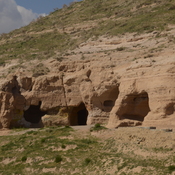
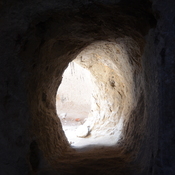
Maragheh, Rasadkhana caves
Maragheh, Rasadkhana caves
Maragheh (2 km)
Parthian village
The so-called Mithraic cave (7 km)
The so-called Mithraic cave