
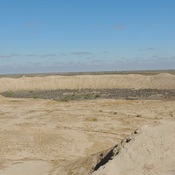
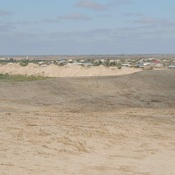
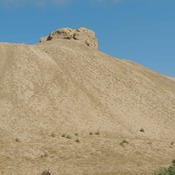
By the beginning of the eighth century CE, suburbs had risen near the Majan canal which flowed a kilometre west of Gyaur Kala city wall. When Abbasid Abu Muslim established dynastic power in February 748 CE, he relocated the government buildings and major bazaars from the ancient city to a location near the suburb. Merv prospered at this site under the Abbasids and Tahirids, but went through a period of decline when political power moved to Nishapur and Bukhara.
The Seljuks arrived in the eleventh century CE and revived the city, establishing Merv as their eastern capital and calling it Marv al-Shahijan (today called Sultan Kala). In the process, they built fortification walls around the suburbs, a task that was completed at the end of the eleventh century during the reign of Sultan Malikshah (1072-92 CE).
Sultan Sanjar (1118-57 CE) is credited with construction of a fortified citadel, the Shahriyar Ark, in the northeast corner, and two additional walled suburbs that extended the city to the north and south. The Shahriyar Ark citadel enclosed a palace complex, administrative buildings and residences for the elite.
In 1221 CE, a Mongol army advanced on Merv and its cavalry rode around the walls for spent six days looking for the weak points. The terrified residents negotiated a surrender which only served to open the gates and allow the Mongols to enter, after which they proceeded to massacre the townspeople and burn the town.
The city remained occupied, an impoverished shadow of its former self, until the Timurids integrated the area into their empire in the late 14th century CE.

Location:
- Turkmenistan, Bagt
- geo:37.662792,62.173447
- Location ± 0-5 m.
Period or year:
- 8xx / 1221
Class:
- City
- visible
Identifiers:
- vici:place=31761
Annotations
Nearby
Sultan Sandjar mausoleum (601)
Sultan Sandjar mausoleum.
Merv - Antiochia in Margiana - Alexandria (1 km)
OmnesViae import TPPlace2736. Oasis-city in Central Asia, on the historical Silk Road.
Anonymous settlement (625) (1 km)
Sasanian & medieval settlement (0,48 ha).