
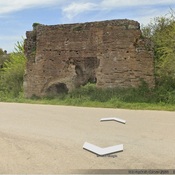
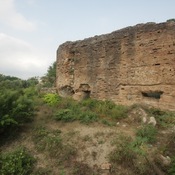
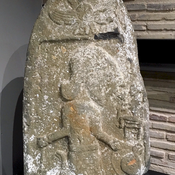
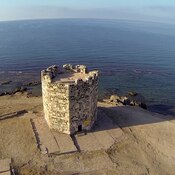

Aiges (Ancient Greek: Aigai or Aigeai) was a Macedonian military colony of the times of Alexander the Great or the Seleucids in coastal Cilicia. Originally the site was settled by the Macedonian settlers from Aiges and was an important center of the Seleucids, until it fell to the Roman general Pompey in 64 BC. Tacitus also mentions the Aiges in his"Chronicles", XIII. Apollonius Tyanaeus carried out his first studies at the beginning of the 1st century in Cilician Aigai. Later Saint Thallelaus was martyred there in the years of Numerianos (283-284). The famous sanctuary of Asklepios was destroyed by Christians in the 4th century. After the fall of Ptolemaic Palestine, Aiges became a center of trade between East and West. From the city of Aigai, Marco Polo started his long journey to China in 1271.
In the Middle Ages also known as Laiazzo.
Strabo from Amasya mentioned Aigai in his work Geographika - After Mallus one comes to Aegaea e, a small town, with a mooring-place; and then to the Amanides Gates, with a mooring-place, where ends the mountain Amanus, which extends down from the Taurus and lies above Cilicia towards the east. It was always ruled by several powerful tyrants, who possessed strongholds; but in my time a notable man established himself as lord of all, and was named king by the Romans because of his manly virtues — I refer to Tarcondimotus, who bequeathed the succession to his posterity1.
Sources:
- Strabo. Geographica. Book XIV, Chapter 5 , 18
- Lucan, The Civil War, Pharsalia: Book III-Lucan (39–65) - The Civil War, Pharsalia: Book III (poetryintranslation.com)
- Cornelius Tacitus. Annals. XIII.8
- Eusebius: Vita Constantini 3,56,1 f.
- St. Thalelaeus - Saints & Angels - Catholic Online
References
- ↑The Geography of Strabo, Book XIV, Chapter 5 , 18 - http://penelope.uchicago.edu/Thayer/E/Roman/Texts/Strabo/14E*.htm