Es gibt noch keine deutschsprachige Anmerkungen. Präsentiert wirden Anmerkungen auf English.
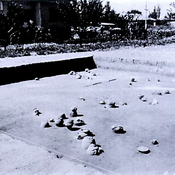
Acemhoyuk - Acem Mound is a large mound ca 44 ha located in the village of Yeşilova to the South of Ankara on the southeastern end of the Tuz Gölü, in a fertile plain. Acemhoyuk is identified as ancient Purushanda/Burushattum1or Zalpa3. It has been inhabited from the Chalcolithic and Early Bronze Ages. It flourished during Assyrian Colony Period i.e. the first quarter of the second millennium BC, as a karum - merchants' colony. There were, aparat from private houses, monumental palaces destroyed by the great fire4The palace at the south side of the tumulus (outside the karum) is called Sarıkaya, and the one at the north - west is called Hatipler Palace. Excavations revealed architecture consisting of mudbrick buildings with rectangular or crooked plans from the EBA period. The houses had stone foundations, floors of compressed soil and flat roofs5. Excavations in palace rooms yielded ivory works of the furnitures, crystal and obsidian vases, differen bronze objects and clay bullae stamped with seal and inscribed clay tablets. Some rooms - store-rooms were furnished with large pithoi. At the end of that period Acemhoyuk lost its importance and was deserted. The SW part of the mound was inhabited in the Early Hellenistic and Rome Periods 6.
See:
- http://tayproject.org/TAYmaster.fm$Retrieve?YerlesmeNo=10&html=masterDetail.html&layout=web
- http://dergiler.ankara.edu.tr/dergiler/14/700/8856.pdf
- Joost Blasweiler, Acem Höyük (2) : Burušhattum –Purušhanda !?-https://www.academia.edu/7597661
- idem, Purušhanda and the Old Kingdom of Hattusa - https://www.academia.edu/20278742
- idem: Were the Sarikaya Palace and the Hatipler Tepesi built as two palaces at the same time in Acemhöyük?, Arnhem (nl) Anatolia in the Bronze Age 2018 no.4
- Gojko Barjamovic, ‘‘A Commercial Geography of Anatolia,’ in L. Ullmann and M. Weeden (eds) Hittite Landscape and Geography. Leiden: Brill. 2017, p. 312
- Charles Burney, Historical Dictionary of the Hittites, Scarecrow Press 2004, sv. Acemhoyuk] [http://www.transanatolie.com/english/turkey/anatolia/ancient%20cities/Acemhoyuk/acemhoyuk.htm]
- Aysen Açıkkol, Isın Günay, Emel Akpolat , Erksin Güleç, A middle bronze age case of trephination from central Anatolia, Turkey in: Bulletin of the International Association for Paleodontology. 2009; 3(2):p. 30
- Ekrem Akurgal, Ancient Civilisations and Ruins of Turkey: From Prehistoric Times until the end of the RomanTurkish Historical Society Press, Ankara 1970, p. 323
Referenzen
- ↑ Charles Burney, 2004, sv. Acemhoyuk
- ↑ Charles Burney, 2004, sv. Acemhoyuk
- ↑Aysen Açıkkol el all. 2009; 3(2):p.30
- ↑Ekrem Akurgal, 1970, p. 323
- ↑http://www.transanatolie.com/english/turkey/anatolia/ancient%20cities/Acemhoyuk/acemhoyuk.htm
- ↑Ekrem Akurgal, 1970, p. 323
Acemhoyuk - Acem Mound is a large mound ca 44 ha located in the village of Yeşilova to the South of Ankara on the southeastern end of the Tuz Gölü, in a fertile plain. Acemhoyuk is identified as ancient Purushanda/Burushattum1or Zalpa3. It has been inhabited from the Chalcolithic and Early Bronze Ages. It flourished during Assyrian Colony Period i.e. the first quarter of the second millennium BC, as a karum - merchants' colony. There were, aparat from private houses, monumental palaces destroyed by the great fire4The palace at the south side of the tumulus (outside the karum) is called Sarıkaya, and the one at the north - west is called Hatipler Palace. Excavations revealed architecture consisting of mudbrick buildings with rectangular or crooked plans from the EBA period. The houses had stone foundations, floors of compressed soil and flat roofs5. Excavations in palace rooms yielded ivory works of the furnitures, crystal and obsidian vases, differen bronze objects and clay bullae stamped with seal and inscribed clay tablets. Some rooms - store-rooms were furnished with large pithoi. At the end of that period Acemhoyuk lost its importance and was deserted. The SW part of the mound was inhabited in the Early Hellenistic and Rome Periods 6.
See:
- http://tayproject.org/TAYmaster.fm$Retrieve?YerlesmeNo=10&html=masterDetail.html&layout=web
- http://dergiler.ankara.edu.tr/dergiler/14/700/8856.pdf
- Joost Blasweiler, Acem Höyük (2) : Burušhattum –Purušhanda !?-https://www.academia.edu/7597661
- idem, Purušhanda and the Old Kingdom of Hattusa - https://www.academia.edu/20278742
- idem: Were the Sarikaya Palace and the Hatipler Tepesi built as two palaces at the same time in Acemhöyük?, Arnhem (nl) Anatolia in the Bronze Age 2018 no.4
- Gojko Barjamovic, ‘‘A Commercial Geography of Anatolia,’ in L. Ullmann and M. Weeden (eds) Hittite Landscape and Geography. Leiden: Brill. 2017, p. 312
- Charles Burney, Historical Dictionary of the Hittites, Scarecrow Press 2004, sv. Acemhoyuk] [http://www.transanatolie.com/english/turkey/anatolia/ancient%20cities/Acemhoyuk/acemhoyuk.htm]
- Aysen Açıkkol, Isın Günay, Emel Akpolat , Erksin Güleç, A middle bronze age case of trephination from central Anatolia, Turkey in: Bulletin of the International Association for Paleodontology. 2009; 3(2):p. 30
- Ekrem Akurgal, Ancient Civilisations and Ruins of Turkey: From Prehistoric Times until the end of the RomanTurkish Historical Society Press, Ankara 1970, p. 323
Referenzen
- ↑ Charles Burney, 2004, sv. Acemhoyuk
- ↑ Charles Burney, 2004, sv. Acemhoyuk
- ↑Aysen Açıkkol el all. 2009; 3(2):p.30
- ↑Ekrem Akurgal, 1970, p. 323
- ↑http://www.transanatolie.com/english/turkey/anatolia/ancient%20cities/Acemhoyuk/acemhoyuk.htm
- ↑Ekrem Akurgal, 1970, p. 323