Es gibt noch keine deutschsprachige Anmerkungen. Präsentiert wirden Anmerkungen auf English.
The castle was built during the Roman Empire. But it was used during the Byzantine Empire and the Armenian Kingdom of Cilicia. It probably controlled ancient and medieval caravan routes.
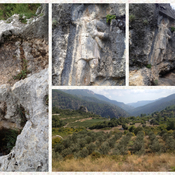
The castle is on a hill overlooking Karakız valley. Most of the buildings as well as the walls are in ruins. But a big room, known as the queen’s room, survives. There are also two small compartments which are thought to be toilet and some dark quarters which may be dungeons. Next to the main gate there is a rock relief showing two soldiers and one pregnant woman. There is also a highly effaced inscription.
In the inscription a certain Siramar (sir Amaury) is mentioned in newly appeared Armenian inscription of Dağlı kalesi, yet unidentified castle of Armenian Kingdom of Cilicia and Isauria (Western Cilicia). Prof. Karen Matevosyan suggests new reading of the inscription that is dated 1235 or 1245, by the reign of Hetum I, king of Armenia (1226-1269).
Unfortunately the inscription stone had been removed and stolen in 2013.
The castle was built during the Roman Empire. But it was used during the Byzantine Empire and the Armenian Kingdom of Cilicia. It probably controlled ancient and medieval caravan routes.
The castle is on a hill overlooking Karakız valley. Most of the buildings as well as the walls are in ruins. But a big room, known as the queen’s room, survives. There are also two small compartments which are thought to be toilet and some dark quarters which may be dungeons. Next to the main gate there is a rock relief showing two soldiers and one pregnant woman. There is also a highly effaced inscription.
In the inscription a certain Siramar (sir Amaury) is mentioned in newly appeared Armenian inscription of Dağlı kalesi, yet unidentified castle of Armenian Kingdom of Cilicia and Isauria (Western Cilicia). Prof. Karen Matevosyan suggests new reading of the inscription that is dated 1235 or 1245, by the reign of Hetum I, king of Armenia (1226-1269).
Unfortunately the inscription stone had been removed and stolen in 2013.