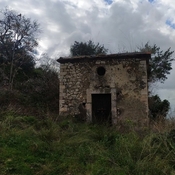
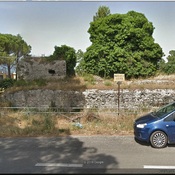
Il n'y a pas une annotation en français. Présenté est une annotation en Anglais.
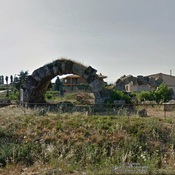
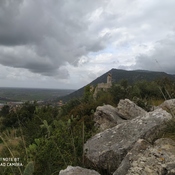
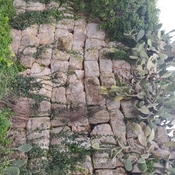
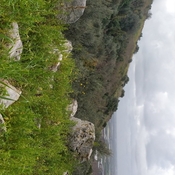
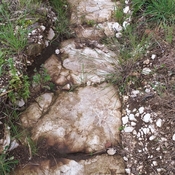
The Appianus Road, whose construction began in 312 BC, is the oldest, and perhaps the most famous Roman road. It started at the Roman Forum at Milliarium Aureum and connected Rome with Capua and then extended south to the port city of Brundisium on the Adriatic coast. There Via Appia picked up the coastal road at Tarracina (Terracina). The road is named after Appius Claudius Caecus, the Roman censor who began and completed the first section as a military road to the south during the Samnite Wars1. Around the half-century later the road was paved and extended all the way to Brundisium. Half of the trail was marked out by Forum Appius(Torre del Mercato), known for the fact that Christians went there to meet St. Paul (Acts 28:15)
See:
- Titus Livius, Ab Urbe condita, / Livy. Books VIII-X With An English T ranslation. Cambridge. Cambridge, Mass., Harvard University Press; London, William Heinemann, Ltd. 1926, Book IX, 29
- Via Appia, Infogalactic: the planetary knowledge core, , 7 January 2016, 08:00 UTC, Infogalactic: the planetary knowledge core, , 7 January 2016, 08:00 UTC,
- Ill Cammino dell`Appia Antica, Terracina in Roman times, https://www.camminodellappia.it/en/2020/09/29/terracina-in-roman-times/
- It started at the Roman Forum and led south through the Capua Gate (Porta Capena) to the area of Capua near Naples.
Références
- ↑noteworthy, too, in that year was the censorship of Appius Claudius and Gaius Plautius; but the name of Appius was of happier memory with succeeding generations, because he built a road, and conveyed a stream of water into the City
The Appianus Road, whose construction began in 312 BC, is the oldest, and perhaps the most famous Roman road. It started at the Roman Forum at Milliarium Aureum and connected Rome with Capua and then extended south to the port city of Brundisium on the Adriatic coast. There Via Appia picked up the coastal road at Tarracina (Terracina). The road is named after Appius Claudius Caecus, the Roman censor who began and completed the first section as a military road to the south during the Samnite Wars1. Around the half-century later the road was paved and extended all the way to Brundisium. Half of the trail was marked out by Forum Appius(Torre del Mercato), known for the fact that Christians went there to meet St. Paul (Acts 28:15)
See:
- Titus Livius, Ab Urbe condita, / Livy. Books VIII-X With An English T ranslation. Cambridge. Cambridge, Mass., Harvard University Press; London, William Heinemann, Ltd. 1926, Book IX, 29
- Via Appia, Infogalactic: the planetary knowledge core, , 7 January 2016, 08:00 UTC, Infogalactic: the planetary knowledge core, , 7 January 2016, 08:00 UTC,
- Ill Cammino dell`Appia Antica, Terracina in Roman times, https://www.camminodellappia.it/en/2020/09/29/terracina-in-roman-times/
- It started at the Roman Forum and led south through the Capua Gate (Porta Capena) to the area of Capua near Naples.
Références
- ↑noteworthy, too, in that year was the censorship of Appius Claudius and Gaius Plautius; but the name of Appius was of happier memory with succeeding generations, because he built a road, and conveyed a stream of water into the City