
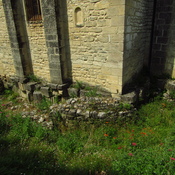
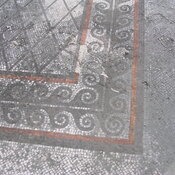
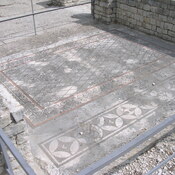
The public bathhouse of the La Villasse archaeological site was constructed in the second or third decade of the first century CE and included multiple rooms, likely a changing room (apodyterium), cold-water room (frigidarium), tepid-water room (tepidarium), and hot-water room (caldarium). The latter two rooms were heated by an underground hollow space filled with hot air (hypocaustum), the temperature of which was controlled by means of a wood-burning furnace bordering on the baths on the east. Just south of the bathhouse lay a large open area surrounded by porticoes which has been identified as an exercising field or palaestra; in fact, the bathhouse was entered via the northern portico of this complex. Across what was likely a street to the west of the bathhouse, in the northern part of the vast "Maison au dauphin", lay the private bathing quarters of this mansion; the two bathing complexes were likely supplied with water via the same channels.

Umgebung:

Lage:
- Frankreich, Vaison-la-Romaine
- geo:44.242046,5.071499
- Lage ± 0-5 m.
Period or year:
- 10~ / unknown
Klassification:
- Thermen
- Sichtbar
Identifiers:
- vici:place=14592
Anmerkungen
The public bathhouse of the La Villasse archaeological site was constructed in the second or third decade of the first century CE and included multiple rooms, likely a changing room (apodyterium), cold-water room (frigidarium), tepid-water room (tepidarium), and hot-water room (caldarium). The latter two rooms were heated by an underground hollow space filled with hot air (hypocaustum), the temperature of which was controlled by means of a wood-burning furnace bordering on the baths on the east. Just south of the bathhouse lay a large open area surrounded by porticoes which has been identified as an exercising field or palaestra; in fact, the bathhouse was entered via the northern portico of this complex. Across what was likely a street to the west of the bathhouse, in the northern part of the vast "Maison au dauphin", lay the private bathing quarters of this mansion; the two bathing complexes were likely supplied with water via the same channels.
Thermes gallo-romains du Nord de Vaison-la-Romaine
In der Nähe
Vaison, palaestra
Vaison-la-Romaine, palaestra (exercise field) with surrounding porticoes.
Villasse Archäologische Stätte (Vaison-la-Romaine)
Villasse Archäologische Stätte (Vaison-la-Romaine)
Vaison, "Maison au buste d'argent"
Vaison-la-Romaine, "Maison au buste d'argent"