Es gibt noch keine deutschsprachige Anmerkungen. Präsentiert wirden Anmerkungen auf English.
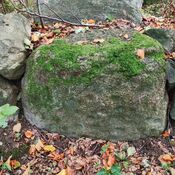
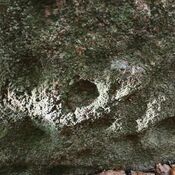
Æbleskivestenen (Pancake Stone) is a large erratic boulder approximately three meters long and two meters wide. The stone features no less than 105 distinct cup marks (skåltegn) carved into its surface, though older records sometimes mention 83 depressions. These cup marks are the most common form of rock carvings found in the Danish region, typically dated to the Bronze Age.
While their precise meaning remains enigmatic, they are widely interpreted as sacred fertility symbols and are strongly linked to the period's concentration on sun worship and religious ceremonies vital for the inhabitants' prosperity. The stone itself served as a powerful gathering spot for these cultic activities.
Æbleskivestenen was one of the earliest sites to receive official protection, being voluntarily preserved in 1875, decades before the general cultural heritage law of 1937.
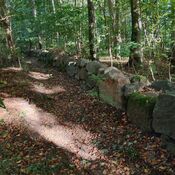
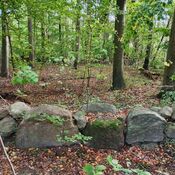
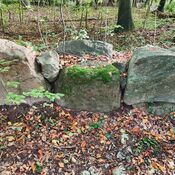
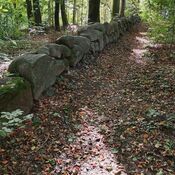
In 1875, Theobald Weber created a small, circular enclosure around the stone, utilizing 13 to 14 smaller quernstones found in the area to complete the monument. The site, which holds great national importance, remains openly accessible.
https://www.kulturarv.dk/fundogfortidsminder/Lokalitet/9091/
Æbleskivestenen (Pancake Stone) is a large erratic boulder approximately three meters long and two meters wide. The stone features no less than 105 distinct cup marks (skåltegn) carved into its surface, though older records sometimes mention 83 depressions. These cup marks are the most common form of rock carvings found in the Danish region, typically dated to the Bronze Age.
While their precise meaning remains enigmatic, they are widely interpreted as sacred fertility symbols and are strongly linked to the period's concentration on sun worship and religious ceremonies vital for the inhabitants' prosperity. The stone itself served as a powerful gathering spot for these cultic activities.
Æbleskivestenen was one of the earliest sites to receive official protection, being voluntarily preserved in 1875, decades before the general cultural heritage law of 1937.
In 1875, Theobald Weber created a small, circular enclosure around the stone, utilizing 13 to 14 smaller quernstones found in the area to complete the monument. The site, which holds great national importance, remains openly accessible.
https://www.kulturarv.dk/fundogfortidsminder/Lokalitet/9091/