
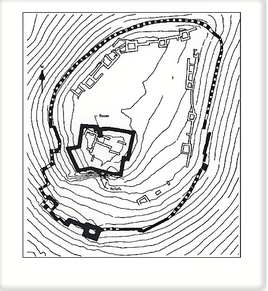
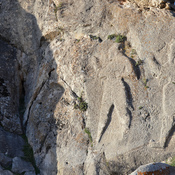
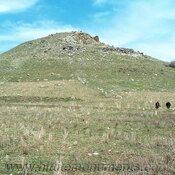
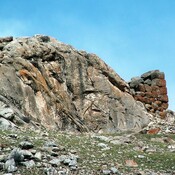
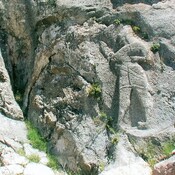
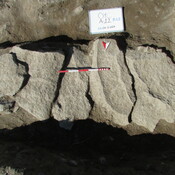
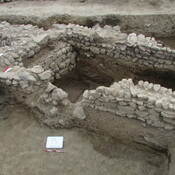

Gavurkale was discovered by Georges Perrot and Edmond Guillaumein 1861. The first excavations were carried out by Von der Osten and and Erich Friedrich Schmid in 1930. Kay Kohlmeyer visited the site in the late 1970s and published a detailed description. In the years 1993-1998, Stephen Lumsden carried out extensive surveys and excavations on Gavurkale and the surrounding area on behalf of Bilkent University in Ankara. Finally, in 2005, Horst Ehringhaus provided further documentation of the works in his book on the rock reliefs of the Hittite empire period.
Sources:
- Hans Hennig von der Osten, Discoveries in Anatolia 1930-1931 in: Oriental Institute Communications 14, 1933, pp. 56-90, (Gavur-kalesi)
- Kay Kohlmeyer: Felsbilder der hethitischen Großreichszeit. In: Acta Praehistorica et Archaeologica 15 / 1983, pp.. 43–48
- Stephen Lumsden: Investigations at a Hittite Sacre,d Place In: Recent Developments in Hittite Archaeology and History: Papers in Memory of Hans G. Güterbock. Eisenbrauns 2002 pp. 111–125
- Garry Beckman, Intrisic and Constructing Sacred Space in Hittite Anatolia, in: Heaven on Earth: Temples, Ritual, and Cosmic Symbolism in the Ancient World, Oriental Institute of the University of Chicago, 2013, pp. 153-173
- Hartmut Kühne,“Gavur Kalesi, ein Ort der Ahnenverehrung?” In: Kulturgeschichten: Altorientalische Studien für Volkert Haas zum 65. Geburtstag, edited by Thomas Richter, Doris Prechel, and Jörg Klinger, Saarbrücker Verlag und Druckerei. 2001, 227-243
- Hans Gustav Güterbock, K Aslihan Yener; Harry A Hoffner; Simrit Dhesi: Recent Developments in Hittite Archaeology and History: Papers in Memory of Hans G. Güterbock, Eisenbrauns, 2002
- Halil Hamdi Ekiz, “Gavurkalesi (Gavurkale) Kaya Anıtı” Anadolu Medeniyetleri Müzesi 2007-2008 Yıllığı, Ankara, 2009, pp. 213-226