There is no English annotation yet. Presented is an annotation in German.
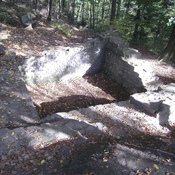
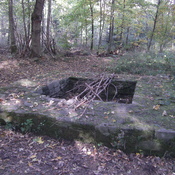
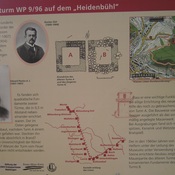
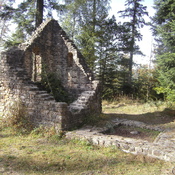
Approximately 30 meters west of the Limes wall, the rubble walls of a Roman small fort can be seen in the forest. This fort was partially excavated in 1895 by the Imperial Limes Commission. The roughly 480 square meter complex had an almost square shape with rounded corners and was enclosed by walls 0.80–0.90 meters thick. The only gate was located to the east, facing the border's course. No surrounding ditch could be detected during the excavations. The interior areas of the fort have only been partially investigated. It is presumed that the construction consisted of a barrack built in timber-frame style with a horseshoe-shaped layout.
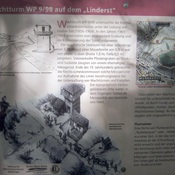
Modern technology, such as laser scans, reveals the rubble wall of the fort's walls and the course of ditches/walls along the Limes (LID Baden-Württemberg). Findings suggest that the fort was built towards the end of the 2nd century AD and remained in use until the abandonment of the Limes around 260/270 AD. In the 18th century, the site was repurposed for a glassworks facility.
Regarding the interior layout, soldiers were sent from the nearest fort to the outpost, where they monitored a specific section of the border and maintained the defensive structures. At Limes passageways, they controlled traffic.
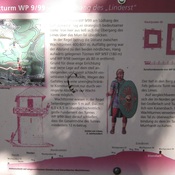
At the small fort near Ebnisee, approximately 20 soldiers were stationed, tasked with overseeing a visually challenging section of the Roman imperial border. South of the fort, the Limes line crossed a small ravine and ascended to watchtower 9/118 further uphill. Small forts strategically secured key positions like passes, river valleys, or Limes passageways. Their layouts and sizes varied considerably.
Source: https://vicusmurrensis.de/2025/03/02/kleinkastell-ebnisee/
Approximately 30 meters west of the Limes wall, the rubble walls of a Roman small fort can be seen in the forest. This fort was partially excavated in 1895 by the Imperial Limes Commission. The roughly 480 square meter complex had an almost square shape with rounded corners and was enclosed by walls 0.80–0.90 meters thick. The only gate was located to the east, facing the border's course. No surrounding ditch could be detected during the excavations. The interior areas of the fort have only been partially investigated. It is presumed that the construction consisted of a barrack built in timber-frame style with a horseshoe-shaped layout.
Modern technology, such as laser scans, reveals the rubble wall of the fort's walls and the course of ditches/walls along the Limes (LID Baden-Württemberg). Findings suggest that the fort was built towards the end of the 2nd century AD and remained in use until the abandonment of the Limes around 260/270 AD. In the 18th century, the site was repurposed for a glassworks facility.
Regarding the interior layout, soldiers were sent from the nearest fort to the outpost, where they monitored a specific section of the border and maintained the defensive structures. At Limes passageways, they controlled traffic.
At the small fort near Ebnisee, approximately 20 soldiers were stationed, tasked with overseeing a visually challenging section of the Roman imperial border. South of the fort, the Limes line crossed a small ravine and ascended to watchtower 9/118 further uphill. Small forts strategically secured key positions like passes, river valleys, or Limes passageways. Their layouts and sizes varied considerably.
Source: https://vicusmurrensis.de/2025/03/02/kleinkastell-ebnisee/