
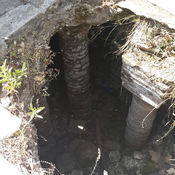

Aliquot's temple A1.
Roman era (2nd century AD) temple on site of earlier temple of Baal Markadi or Marqod. Destroyed in the earthquake of 551 AD. Nearby (ca. 300m) there are also a temple of Juno, Roman baths and other structures. For inscriptions from Deir al Qal'a see CIL III; Inscriptiones Asiae, provinciarum Europae Graecarum, Illyrici Latinae. Edidit TH. MOMMSEN. 1873, pars I. Chap. XX, p. 29 at http://arachne.uni-koeln.de/item/buchseite/534611.
The prostyle of this temple opens north west. Two columns are visible outside measuring over 5 feet in diameter. A third is built into the monastery wall, and a fourth can be seen in the crypt of themonastery. The monastery is built on the temple foundation, the door of the monastery being exactly on the site of the original temple, but the walls of the temple extend further east than the monastery and can be partially seen at the east end2. Taylor (p. 15) claims to have seen a bas-relief of "Jupiter Heliopolitan" or "Haddad" at this site, similar to that found at Baalbek, but I have not been able to find it.
Aliquot adds that there was no podium and that there were two interior staircases allowing access to the upper parts of the temple.
The ruins of the sacred precinct are visible to the north.
Small temple B (Aliquot p. 270) is at the east end of the sacred precinct, a prostylos tetrastylos temple 11.3 m. long by 8.6 m. wide, also opening to the north west.
At the western extremity of the sacred precinct is a large base which may have supported another temple (Aliquot p. 270).
The agglomeration north-east of the temple may be proto-Byzantine according to Aliquot. There are also oil presses of Christian era and a basilica with three naves dated to the 6th century A.D. There are public and private baths (the former partly overlaid by the basilica and a nymphaeum. These are all of Roman era but not clearly dated, as also the inhabited quarter.
References
- ↑Julien Aliquot (2009). La Vie religieuse au Liban sous l'Empire romain: Liban-Nord. Beyrouth : Presses de l’Ifpo, pp. 268-271 Section 36 A-C.
- ↑George Taylor (1967). The Roman Temples of Lebanon. Beirut : Dar el Mashreq Publishers, pp. 12, 15 and plates 85—90