
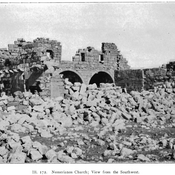
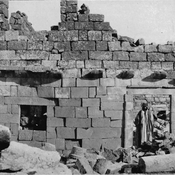
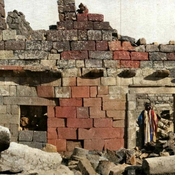
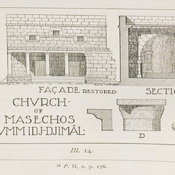
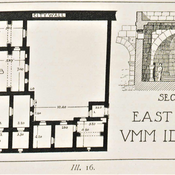
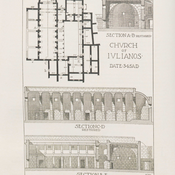
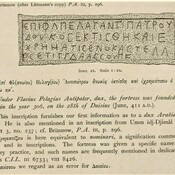
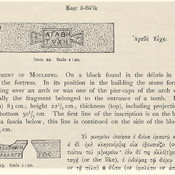

Umm al-Jimal was a Nabatean town which was acquired by the Romans in 106 AD. The late third century the Roman and local settlements are destroyed, perhaps during the Roman suppression of Queen Zenobia’s rebellion in A.D. 275. During Byzantine Period Umm el-Jimal population grew to ten thousand inhabitans.
After an earthquake that hit Umm el-Jimal in A.D. 749 the population of the town gradually decreased and abandoned during the 9th century.
H.C. Butler suggests that this could be ancient Roman Thantia andtim biblical Beth Gamul (Jeremiah 48:23).
See:
- Howard Crosby Butler: Early Churches in Syria. Fourth to Seventh Centuries. Princeton University Press, Princeton 1929, https://archive.org/details/h-c-butler-early-churches-in-syria-fourth-to-seventh-centuries
- Bert de Vries, ADAl XXVII (1993)http://www.ummeljimal.org/doc/de%20Vries%201992%20Umm%20el-Jimal%20Project%201981-1992.pdf
- David Kennedy, The Frontier of Settlement in Roman Arabia: Gerasa to Umm el-Jimal ... and beyond, Mediterraneo Antico 3/2, 2000, pp. 397-453
- http://www.ummeljimal.org/en/history.html
- romeartlover.tripod.com/Ummaljumal.html
- https://bibleatlas.org/beth-gamul.htm
- http://www.ummeljimal.org/doc/UJ%20Education%20Manual%20V1%20Screen%20EN.pdf
- THE UMM: EL-JIMAL PROJECT Butler, H.C. 1913a “Ancient Architecture,” Pp. 149-213 in Syria. Publications of the Princeton University Archaeological Expedition to Syria (Div. II, Part 3, Umm Idj-Djimal, Leyden) 149-213. http://www.ummeljimal.org/doc/Butler%201913a%20Ancient%20Architecture.pdf