
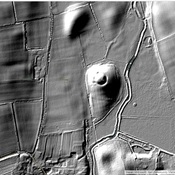

A vast Roman villa with winged corridors and a pavilion-style room with an underfloor heating system on the proposed site of a new bypass in North Yorkshire. Small sections of tessellated mosaic and a concrete floor, covered by wall plaster lying face down on top of it, have been discovered. Pottery from between the mid-3rd and 4th centuries and a nearby ditched enclosure from the late Iron Age Romano-British period were unearthed. Geophysical surveying indicates that the villa is of a substantial size and is set within a landscape of enclosures and field systems.
The masonry walls of the villa have been robbed at some date, with the stones presumably used to build structures somewhere in the vicinity. Cobble foundations upon which the masonry walls were constructed survive within deep foundation trenches, demonstrating the substantial construction of the villa. Within the area stripped by archaeologists, a range of rooms are located on the east side of a four metre-wide north-south aligned corridor within which small areas of tessellated surface survive1.
Used "Bedale, Aiskew and Leeming Bar Bypass Addendum to the Environmental Statement" to determine location.