


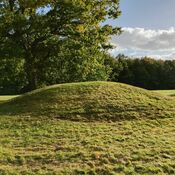
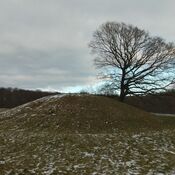
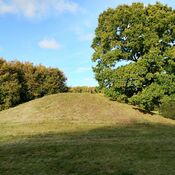
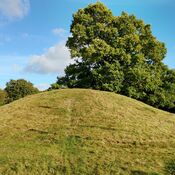
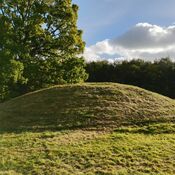
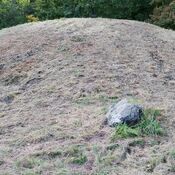
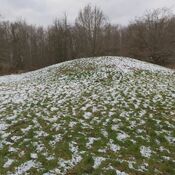
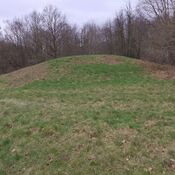
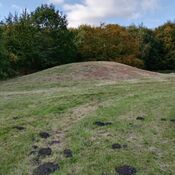
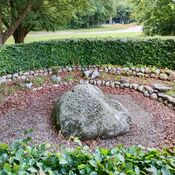
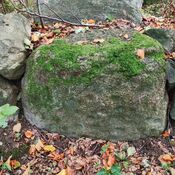
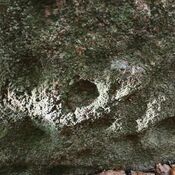
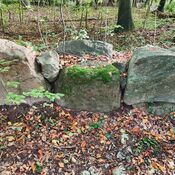
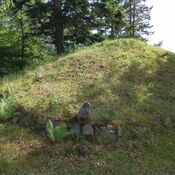
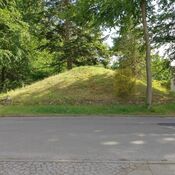
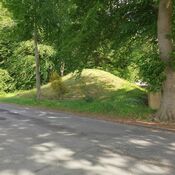
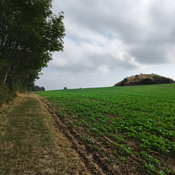
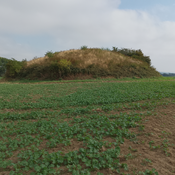
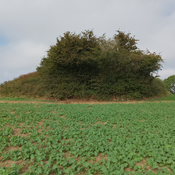

Gammel Hestehave Rundhøj 411712 is classified as a Round Barrow located in Denmark, specifically in Fyn, near the town of Svendborg. It is identified as a site from the Neolithic and Bronze Age. The site is a national heritage monument, protected since 1937 or later.
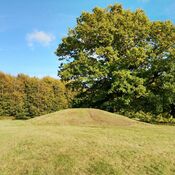
The mound is noted for being impressive. It is considered one of the best-preserved mounds in the area and is the second largest in terms of height and diameter.
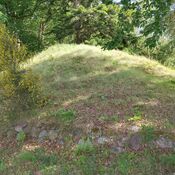
The mound has a total height of 3.5 meters and a diameter of 25 meters. An inspection in 1983 recorded its dimensions as 3.0 meters high by 28.0 x 25.0 meters.
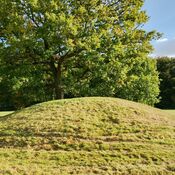
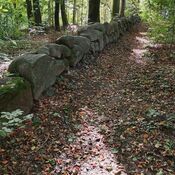
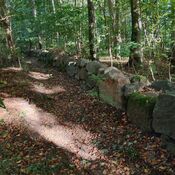
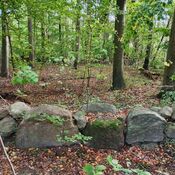
At the foot of the mound, there is a row of curbstones. Above and beside these curbstones, steps have been made, resembling stairs. A small natural path leading to the top is visible due to foot traffic. A large tree grows on one side of the mound. Historically, the mound was described as being covered with grass and fruit trees.
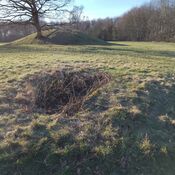
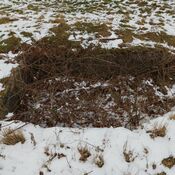
The mound is situated next to a neolithic burial cist (stenkiste).
The mound was historically utilized as a platform for a water tank or water tower dating to the Newer Period (1900–1949 AD). Its placement on the top of the mound was thought to have only damaged the surface superficially.
By 1983, the water tower had been removed, though its round concrete foundation could still be discerned. The stone steps on the eastern side near the top, along with a stone setting at the eastern foot of the mound, are believed to be remnants of a garden facility or landscape feature.
The site has been subject to continuous monitoring and supervision by various authorities, including the National Museum (1947) and Museum Odense (2016, 2019). In 2010, it was designated as a monument of national importance.
----------------------------------------------------------------------------------------------------------------------------------------------------------------------------------------------------------------------------------------------
The Bronze Age landscape at Gammel Hestehave has long held a special attraction for prehistoric people. The first settlements were established along the coastline 5,000 years ago. During the late Stone Age and the early Bronze Age (1900–1100 BC), the settlements relocated slightly further inland, and this period provides the clearest evidence of the area’s importance.
The Monumental Landscape
The Gl. Hestehave settlement was an important meeting place and a crucial community (bygd) located by the Svendborg Sound, overlooking the islands Thurø and Tåsinge.
During the early Bronze Age (1700–1100 BC), a burial field was constructed, containing 23 burial mounds (gravhøje) of varying sizes.
In the Bronze Age, the area was open countryside, allowing the mounds to be seen from far and wide, including Thurø, Tåsinge, and the entire Svendborg Sound. Today, some mounds are partially hidden by forest, but the magic of the monumental Bronze Age landscape can still be sensed.
The mounds were the setting for a village community.
Building the mounds was a labor-intensive process that extended over a long period, meaning that the construction and burials were a shared undertaking for the entire community. The mounds were likely built on pasture and constructed from carefully cut grass turf. The largest mounds required tens of thousands of turf squares, resulting in the surrounding land being infertile for a long time after construction.
The largest of the 23 mounds are about 4 meters high with diameters between 25 and 30 meters, while the smallest vary between 0.5 and 1.5 meters high and measure 12 to 20 meters in diameter.
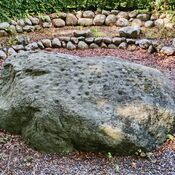
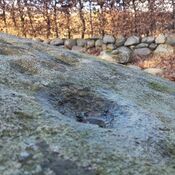
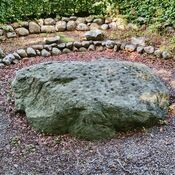
These large burial mounds were built over one, two, or more graves, though none have been professionally examined to confirm the exact number. In addition to the mounds, the area contains a small stone cist and a cup mark stone (“Æbleskivestenen”) featuring carved holy signs.
Bronze Age Society and Culture
The building of thousands of enormous burial mounds in Denmark was a distinct expression of the superior skills of the new Bronze Age society.
This period, which began in Denmark 4,000 years ago saw the emergence of ranked societies in Southern Scandinavia and Central Europe. Power and status were demonstrated through gold and bronze.
Fine weaponry and jewelry followed chosen men and women to their graves.
Never before had such riches been placed in the ground as grave goods for the dead and sacrificial offerings to the powers responsible for fertility. Some mounds were constructed in a manner that preserved the deceased’s chest, leading to Denmark possessing a unique collection of 3,800-year-old costumes, including tunics and cloaks for men and short or long dresses with blouses for women.
The settlement at Gl. Hestehave was involved in European trade, as people sailed out to deal with continental contacts. Exotic acquisitions, such as harness decorations, may have been displayed during special events and processions. The area also functioned as a casting site, where a large crucible and remains of several casting molds have been found. Bronze casting technology was advanced, involving stamping the metal pieces in a wax model, which was then covered with a clay mold. The wax melted out, leaving an imprint for the liquid bronze to fill.
New building practices arose, with people mainly living on scattered, individual farmsteads.
Some longhouses were very large, up to 500 square meters, potentially housing leading families of the community.
Today the area is used for recreational purposes such as dog walking and hiking. There are also mountain bike trails in the forest. Furthermore, there are explanatory signs and benches to sit on.
kulturarv.dk/fundogfortidsminder/Lokalitet/9108/